jeudi 7 juillet 2016

La petite paroisse

Every year, Yseult's parish, Saint-Hélier, has an evening to thank everyone who belongs to and helps the church throughout the year. Some parishioners have been there for three months, others for over thirty years. I went to St. Hélier the very first Sunday that I was in Rennes. It was one of the most beautiful Masses I can remember, where children were dressed in alter robes down to the floor, incense billowed up to the rafters, and hymns were sung in French and Latin. So since I have become what Yseult calls her poussin (little chick), I willingly went with her to this parish dinner. Sixty-five degrees is considered warm weather in Brittany, so everyone carried chairs and lace table cloths out into a small, rain-ladened garden behind the "presbytère" to enjoy the evening. It never ceases to amaze me how hardy Breton people are, nor what wonderful times I have with Yseult, and this night was no exception.  


The first order of business: assemble the apéritif table. Out came bottles of cidre, tiny sea salt crackers, and pistachios, everyone flocking to them so that conversation could officially begin. 

Before all cups were filled, the Curé, Père Paul, announced his joy in seeing everyone and how deeply grateful he was for the love and time poured into Saint-Hélier by each parishioner. Just as people began reshuffling themselves to mingle, another voice piped in, "Attention! On a un petit jeu pour vous tous..." It was the voice of Père Frédéric, the young vicaire with a gentle, playful face who says we are going to play a game. Everyone must pick from a bowl of names, find the person whose name they receive, introduce themselves, and become friends. Yes, tous. Everyone. Even me. I have to find Bruno. 


Luckily though, Yseult and I discover him under a tree with his circle of friends, already engrossed in a lively conversation, a look of pleasant surprise washing over his face to see my unfamiliar little self wandering over. Yseult introduces us, and I am greeted by his friends with several "bis," a light two-cheek kiss that is the equivalent of an American hand shake or a hug. Yet someone calls Yseult away, and so there I am, under a tree, with a group of perfectly fluent Frenchmen. Somehow though, by a grace that I am certain flowed from the general direction of the church, the next hour passed by in what felt like five minutes. 

It was wonderful how interested everyone was by the United States. They asked me what it was like to be an American, what our founding was like, and where religion factored in our present nation. After a while, I stood there for a moment thinking about how beautiful it is the way human beings are really so connected to one another. We may be separated by cultures and the different circumstances of our lives, but even all the way here in France, in an obscure little garden, we were able to effortlessly share the ways we looked at life.

  
It began to lightly drizzle and mist, a normal occurrence here that within ten minutes passes. Père Frédéric comes over and introduces himself. He has only been at Saint-Hélier since 2013 and tells me that he knows what it is like to be the newcomer. He notices I do not have a name tag and without thinking about it, takes off his own and gives it to me, letting me write my name on the back. "Bon, Now you are a part of us," he says.


Meanwhile, a young girl wove in and out of the garden with platters of food that her mom was cooking inside the kitchen. She told us that this was the sixth year they had cooked for this gathering, and now it seems to be becoming a tradition.  

Speaking of tradition, Bretons love their desserts. I do not think I can remember one night where I have not been served some sort of sweet. So once the rain stopped, another table appeared laid with cannelés, tarte aux pommes, and salted butter cake. I have learned that you need to move swiftly, or else it will all disappear. When you first taste Breton specialties though, you understand why! 


The wind soon kicked up and the temperatures dropped quickly, meaning it was time to head home. Père Frédéric told me profusely how thrilled he was to have a young American find Saint-Hélier, and that he would see us again on Sunday. I cannot express the warmth that was shown to me from this parish, nor how much it meant to be with them in their hidden, peaceful place. It was beautiful in a way that I believe can only spring from what is simple and humble, and it was filled with a goodness that is untouchable even by a chaotic world.  


samedi 2 juillet 2016

I guess it's called "Study" Abroad for a reason...

As much as the last few weeks have been an entrance into Breton daily life and culture, they have also been a sobering immersion into intense schoolwork and studying. Every day we begin class at 9:15 a.m. and remain there until 5:00 p.m. (or in French terms, 9h15 à 17h, which I still have yet to get used to.)  I am at the humanities campus of Université de Rennes, along with other Rhodes students and many other students from different countries who are also studying in Brittany this summer. Welcome to what I call, "the space station."


Without a doubt, this has been the most challenging part of my time here in Brittany. The day is quite long and intense, and I often find myself wishing I were out in the city instead of in class for so many hours every day. Becoming a part of this university, however, has given me an insight into French culture and daily habits in such a way that would have otherwise been impossible to attain. Personally, it is here at the university where I receive the heaviest doses of culture shock. It is humbling to say the least, but it reminds me to stay firm in who I am as an American, yet open to new ways of life, knowing that I am trying my best to assimilate as much as possible each day. 


One of the most striking features of Université de Rennes is its modern, almost futuristic architecture. I think that this is very much an integral part of current French interior form though, as even the apartment where I am living is laid out in an economical, sterile, and geometric way; Design seems to be ruled primarily by efficiency. If you can imagine IKEA, you've got the visuals!


We are enrolled in a series of six courses, separated by the groups into which each of us tested. My level takes classes in Advanced French language mechanics, French economics, Breton/French Civilization, Oral comprehension, Written expression, and French Cinema. 


All of my professors are so different, and all so French. In the beginning of the morning we have a language class with our professor, M. Gil Prévôt for two hours. He has quickly become the collective favorite as he is full of energy, delivers plenty of jokes, demands our attention, and has perhaps the heaviest French accent I have ever heard. Even though we are still drowsy when arriving to class, the morning goes by quickly with him. 

Next we have our Economics course, where we more often than not get into some pretty lively debates. Beforehand, I usually snack on a rolled up crêpe aux chocolat that Yseult always buys at the store "à emporter." They are weirdly addictive and I really should stay away from the snack cabinet...but they come in handy because they give me mental energy for this class, which I always need!


And then, there is lunch.
I will just say this, if anyone ever questions the degree to which the French take eating seriously, all they need to do is observe this cafeteria for two minutes. Every person receives a full meal, accompanied by bread and cheese, a yogurt, and a dessert. All hold their forks and knives properly, eating slowly and talking with lowered voices. No rushing goes on in here.


I look forward to this time because it is fascinating to see how the French function in a duly academic and social environment. All of us from Rhodes sit together, and it is always both funny and reassuring to hear about their experiences in different classes and how each person is also adapting to living here. 

I have found that even during breaks from class, the experience of just being at Rennes 2 is a learning lesson in itself. It may be as simple as letting my guard down to speak English for the first time in hours or taking a few moments alone to sit outside. There is a heightened sense of self-awareness, and I very often feel that I am constantly being observed by my professors and other native French speakers, which does intimidate me a bit. At the same time though, being at Rennes 2 has only deepened my love for my country, as I have frequently found myself in situations where I have had to unapologetically defend the goodness of the U.S. and the American spirit. I see this though as a great and unexpected gift.  


After lunch, a few of us usually get a strong cup of coffee or espresso from a small stand outside the Villejean metro station before the afternoon's classes begin. Our classes are varied, sometimes with one class for three hours, other times with two. In between each we take a short "pause café " for about ten minutes to regroup.   


At first, being at school for eight hours a day was very difficult for everyone. I think now though, our unanimous resolve over the grueling schedule has become a bonding factor for us, which helps us get through the work with a positive outlook and always a sense of humor.


But, it never hurts to come back to Yseult making tea with her friend and having some Breton tea cakes at the end of the day.  


dimanche 26 juin 2016

The Mystic Blue of Saint Malo

St. Malo is a minuscule maritime city, walled off from the English Channel that surrounds it on all sides. Nothing seems to better describe Malouins than their phrase, "Ni Français, Ni Breton, Malouin je suis, Malouin je reste"  (Neither French, nor Breton, but I am of St. Malo, forever.) Various greys of granite, slate, and stormy sky dominate this wild coast, and the dramatic vastness of the sea is accentuated by the dismal and yet dazzling weather that seems to change as frequently as the tide. Today, however, the sun makes a rare appearance, illuminating the water below our boat and the sky above us.


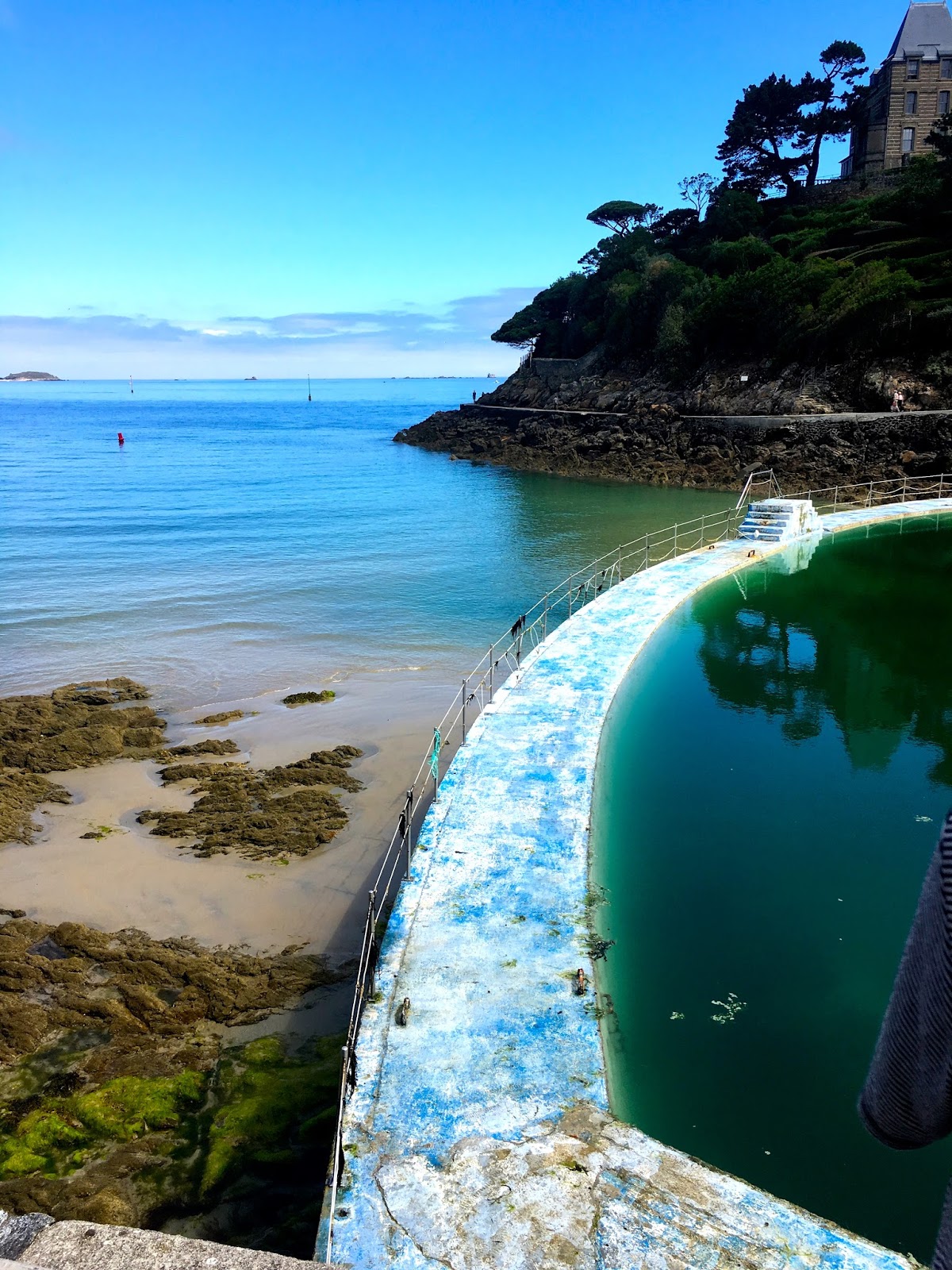
We initially sailed out of Dinard, a resort town just across the water from St. Malo that is frequented by many Brits who traverse the Channel for vacation. The ocean here is a greenish blue that is both bitterly cold and alluring. Visitors walk along rough granite walls that plunge deep into the harbor, diving into the cold water that is enough to fully awaken any sleepy person! If, however, going straight into the ocean is not one's cup of tea, a natural swimming pool lies right on the beach. When the tide comes in, the pool is washed over and filled with sea water, and then when it retreats back out, the water remains. Every high tide then is the pool's own natural mode of replenishment.


When we first drove into Dinard, I gasped at the sight of St. Malo that loomed in the distance, a sight that prior to now I had only imagined from photos. It seems to eerily await its curious visitors who are entranced enough to sail across. No wonder it is often called "La cité corsaire," eluding to its past of plundering pirates. Malouins will tell you, however, that there is a difference between a pirate and a corsair; a pirate simply robs his riches, but a corsair is sent by royal order of the king to do his dirty bidding.   

 St. Malo at a distance is threateningly warlike but also disarmingly helpless. As we approach by boat, I cannot help but imagine the mounting tension that mariners must have felt as they too approached this fortress hundreds of years ago.  


Today, St. Malo is the number one port in northern Brittany, and every fisherman swears he has the freshest catch. There are daily fishing boats that bring in scallops, sardines, mackerel, and sea bass, and the harbor is filled with boats that arrive with fresh hauls of langoustines and oysters. Meanwhile, others set out for weeks at a time, in waters as far away as Ireland, and return with holds of lobster and cod. I am told by a jovial storefront owner who pops his head outside that in every port across Brittany, a "criée," or fish auction, begins as soon as the boats dock and unload.

We had a bit of time to wander around for lunch, so a few of us found an old stone staircase out of the sun. Even inside the town, the wind still smells of the sea.

There is an old Breton saying that goes, "Bretons are born with the waters of the sea flowing 'round their hearts."  After lunch then, we went down to the beach to see the Mor Breizh for ourselves.


There are three fortified islands that form the first line of defense for St. Malo from the encroachment of the sea. The largest of which is called Le Grand Bé, the tomb of French Romantic writer Francois-René de Chateaubriand. Le Grand Bé, however, is only accessible during low tide.


The tides on this coast are deadly, the highest and swiftest in Europe, with incoming waves that can overtake a man at the speed of a galloping horse. There are signs all along the beach to beware of the power of the ocean, warning that if the tide has risen above the walkway up to Grand Bé and a soul is caught behind the water, he must spend the night on the island.

Le Grand Bé

Here and there are isolated bluffs, and the apartments within are surrounded by a single fearsome wall that protects against the bitter winds and relentless waves. The town's architecture can seem rather somber, but it makes me think that this is exactly the way it is meant to be. There are no garish hues that distract from blue of the sky, the softness of the endless beach, or the inky hues of the sea.


It was out of St. Malo that Jacques Cartier first sailed from France to what would become french Canada, and having some Québécois blood myself, there is certainly a sense of pride stirred within me. Up here you can stand above the water from a granite lookout point, watching what is right now a calm ebb and flow become soon a roiling, restless ocean. 


To be honest, there is a loneliness to St. Malo that when first coming here I did not expect. Though it is filled with such vivid beauty, it leaves with me an even more immense feeling of solitude. An old Breton fisherman's prayer puts it perfectly: 

 "O God, Thy sea is so great, and my boat is so small."


vendredi 24 juin 2016

Morning in Dinan, "La médiévale"

Much of the landscape from Rennes up towards the medieval enclave of Dinan is wild and remote, with only the occasional farm that can be spotted from across acres of lush green fields. The morning is resigned to cool, leaden weather that although cumbersome, complements the rusticity of this small, feudal town. As we drive into what looks still like a fortress from the "Moyen Âge," with the oldest house dating back to 1494, my heart leaps at the thought that I am even lucky enough to be here.


Each day I am in Brittany I think about how beautifully my work at school has come together with my journey to this region. This past year, my French studies have revolved around the Arthurian legend and medieval literature, much of which is deeply rooted in Brittany. To be in this place then, and to see before my eyes what I have imagined in my mind for so long is extraordinary.

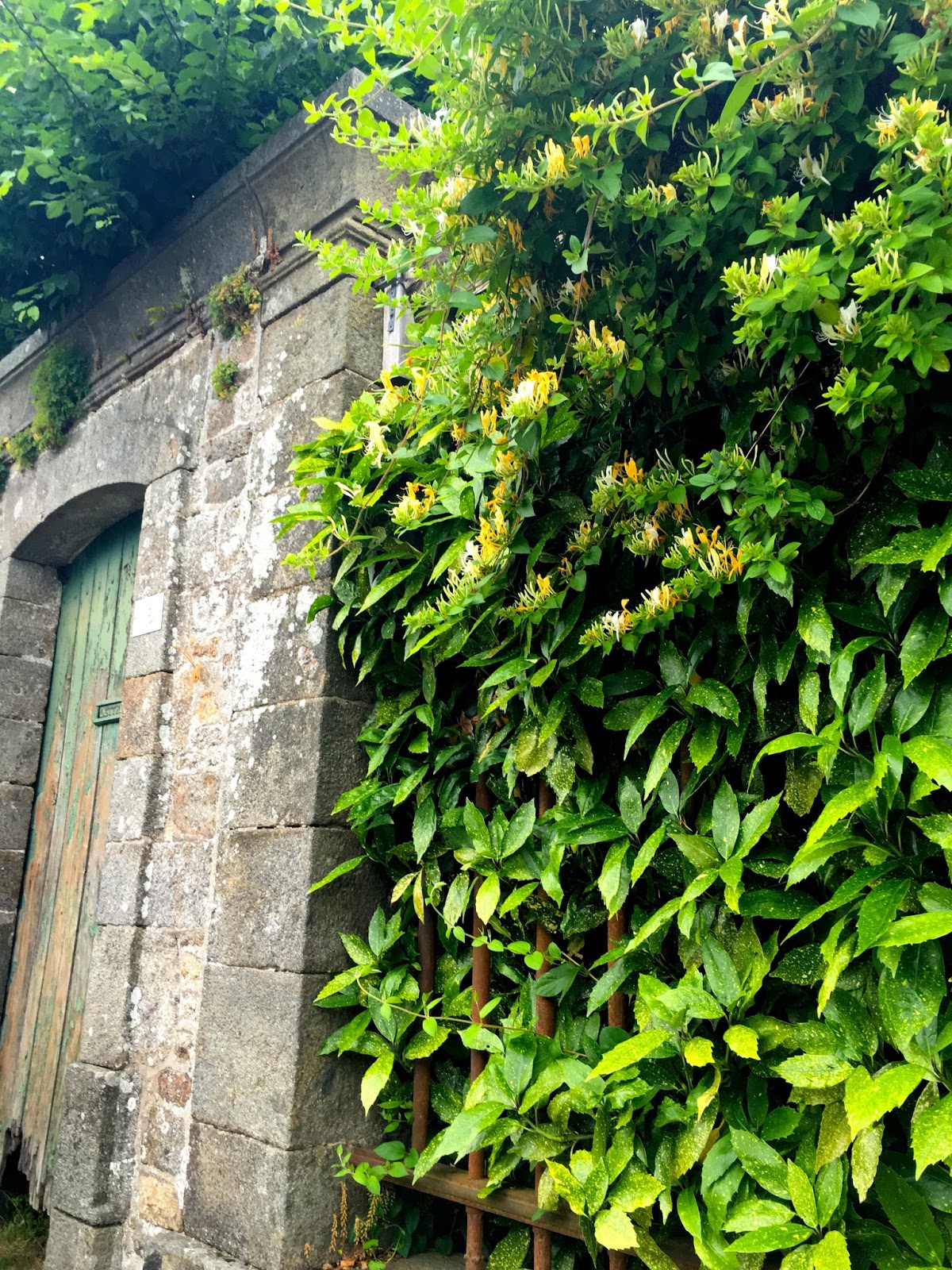
There are reminders everywhere of the magic of this land, even if they are as subtle as a blossoming honeysuckle bush that crawls up an ancient, but enduring granite wall. It is gentle and fragrant, making me think of one of my favorite lais by Marie de France, Le Chèvrefeuille (honeysuckle in French, literally translating to "Goat's ear"). It comes from the myth of the tragic lovers Tristan and Iseut, a classic Breton story that every Breton knows.


Tristan is deeply in love with Iseut, who is his uncle, King Marc's, wife and queen. Tristan is therefore banished from Cornwall. Yet in a plan to see his beloved again, Tristan hides in the woods through which Iseut travels, and taking a hazel branch (le coudrier) covered in delicate honeysuckles (le chèvrefeuille), he carves his name. Once Iseut sees this, she knows that Tristan is closeby, always thinking of her and unable to live without her. Their love forever remains a secret, bound by the limits of their fate that dooms them to be parted. The two thus resemble the honeysuckle, which clings to the hazel branch; Only together, wound with one another can they survive. Separated, they will die.

Leaning off the jagged stones of this old fortress, it is impossible not to feel the thousand years of history beneath my palms. Even though cars can be seen driving by below, I close my eyes for just a second and imagine the cobblestones resounding the journeys of Les Chevaliers de la Table ronde.


Dinan has a small port that lies on La Rance, a river that flows into La Manche (The English Channel) as it reaches the northern coast at Dinard and St. Malo.
  
There is no shortage of regional products here, especially sparkling cider. Shopkeepers with storefronts such as these smile as we look into the windows at the endless cider racks of every strength ranging from "doux" to "brut." 

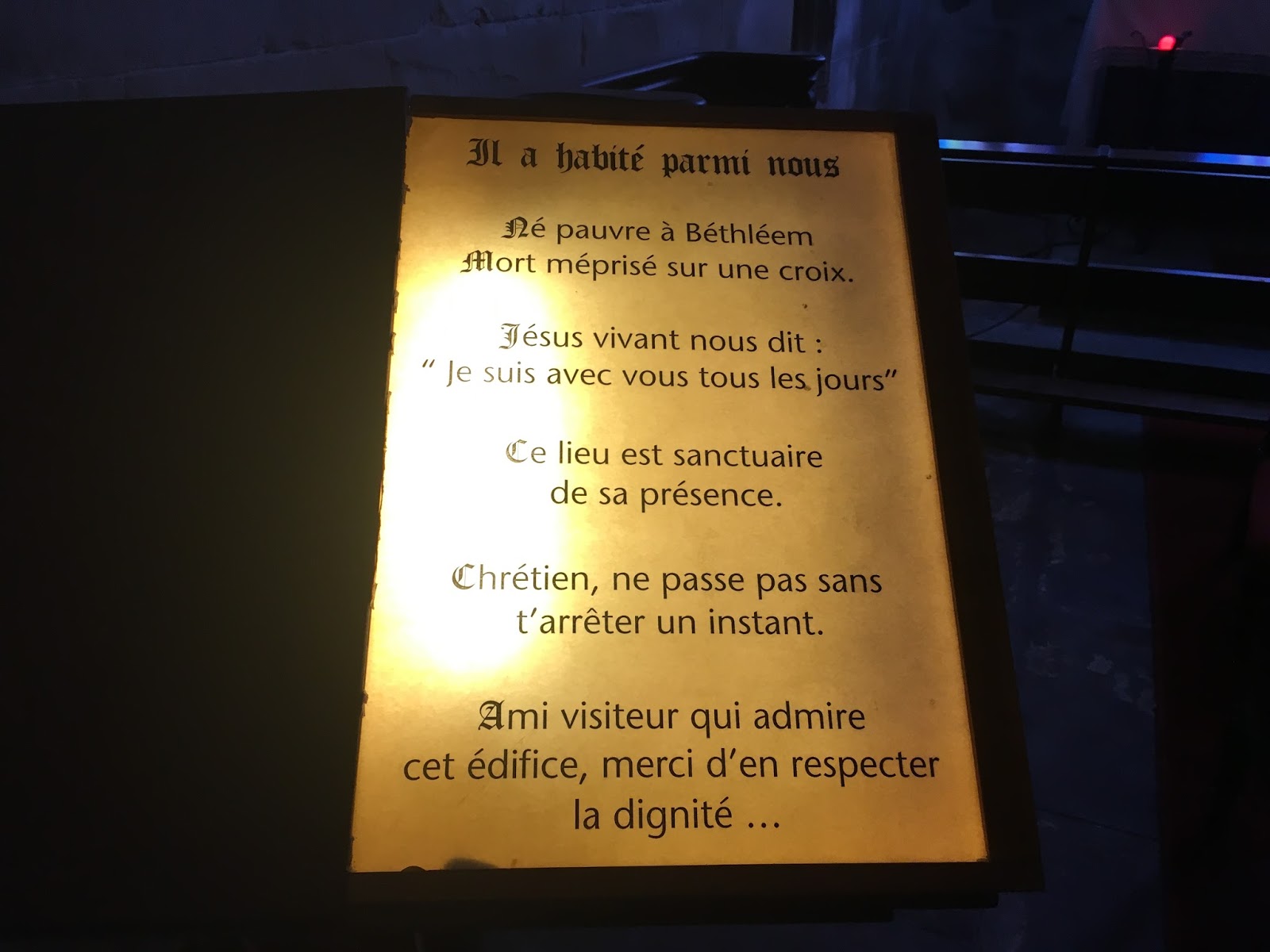
One of the most memorable places in Dinan though is La basilique Saint-Sauveur. This church holds within a concrete cenotaph the heart of a chevalier, Bertrand Du Guesclin, who was a Constable of France during the Hundred Years War. It was eerily beautiful, and every bit of chatter was softly extinguished the moment we lifted our eyes to the ceilings that mimicked heaven and felt the cool, incense-filled air touch our faces.   


It is remarkable that in France, religious orthodoxy is intensely preserved. I have been struck by how deeply traditional the Mass is celebrated here, and how reverence is shown without apology. It is clear that regardless of one's beliefs, a place like this is holy and quiets the heart in a way that cannot be explained. We originally walked around in one group, but we all gradually began to break off, and most spent at least a few moments alone in silence. 

The candle on the right is mine, lit for all of you that I am thinking about, who cannot be here with me. 
    
As we begin to head out, the sun burns through the thick clouds for the first time in almost a week. Though we may not yet be at the sea, you can still smell the iodine and feel the heaviness in the air, boding the presence of a not so far off ocean.